
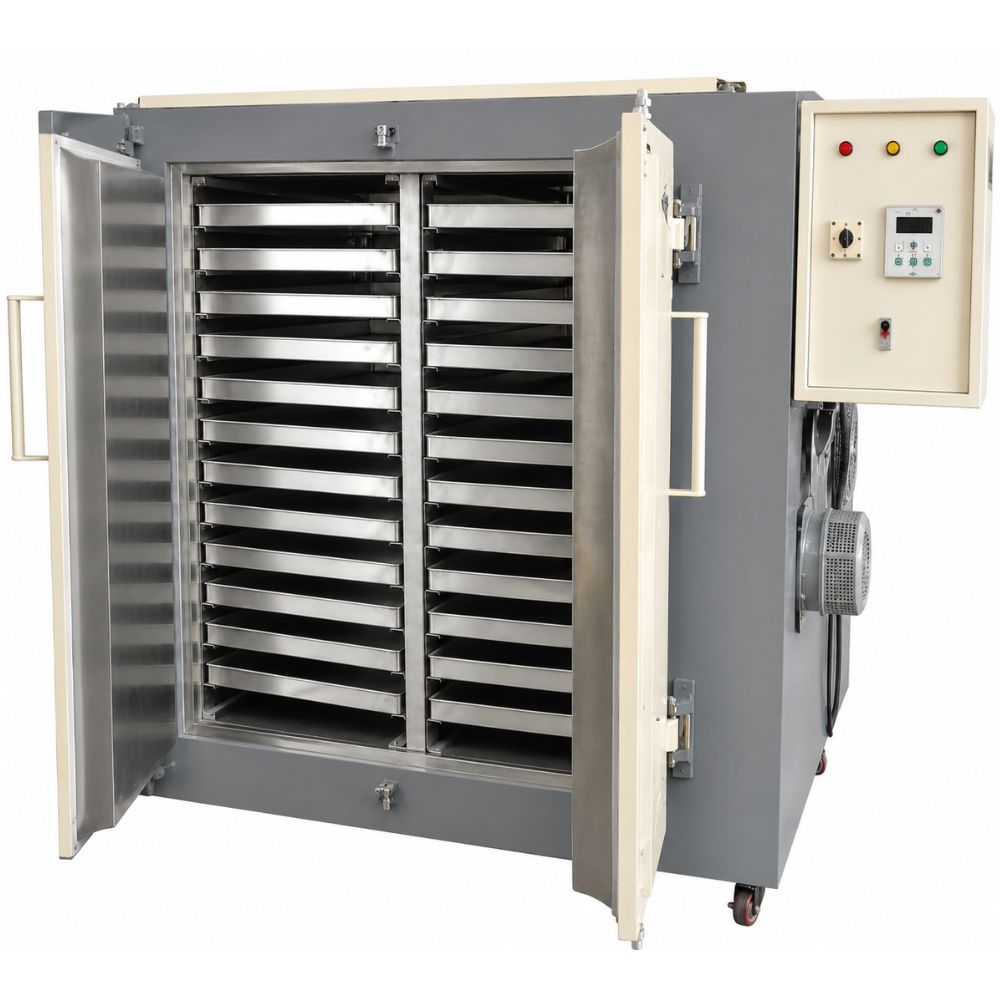
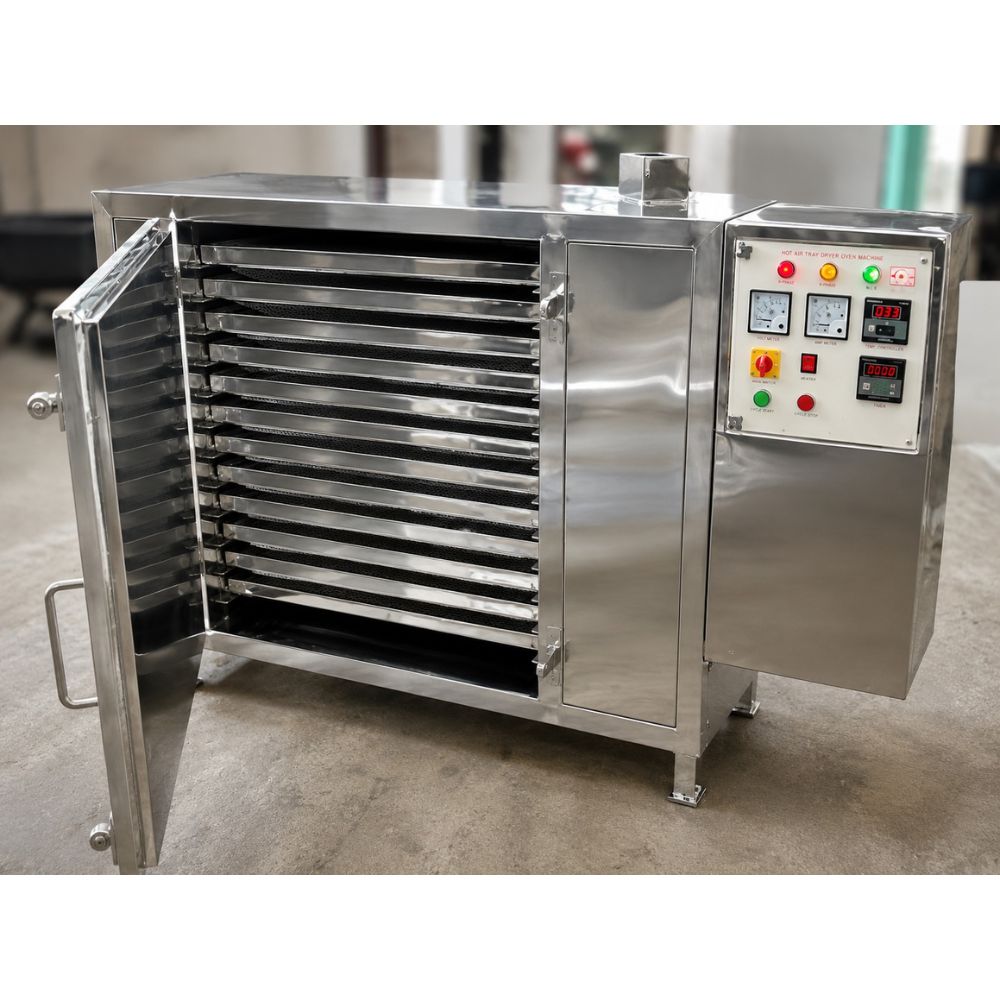
24 Tray Dryer in Mild Steel with SS Tray
Industrial 24 Tray Dryer Manufacturer in India
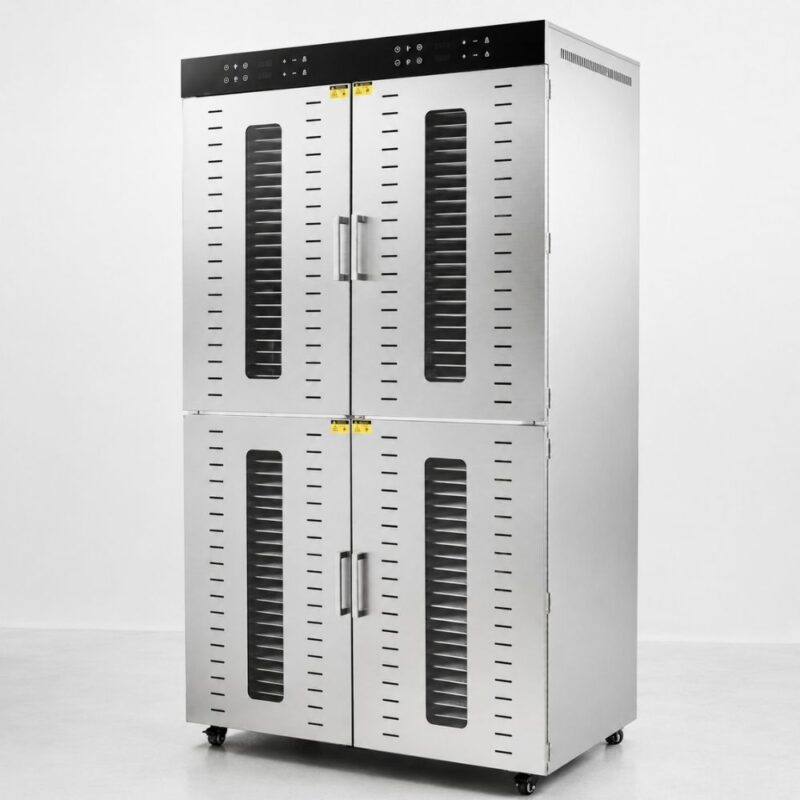
The 24 Tray Dryer in Mild Steel with SS Tray is designed for controlled batch drying of spices, herbs, food products, vegetables, fruits, and other suitable materials that require moisture reduction. It is suitable for medium-scale production requirements in food processing units, spice manufacturing businesses, herbal processing facilities, and other industrial applications.
This tray dryer combines a mild steel (MS) outer construction with stainless steel (SS) trays for holding products during the drying process. The arrangement allows materials to be spread across multiple trays while heated air circulates through the drying chamber. Its configuration can be selected according to the product type, moisture content, drying temperature, and required final moisture level.
The 24 tray configuration provides multiple drying surfaces within one chamber, making it a practical option for businesses that need an organized batch drying process without moving directly to a larger industrial system.
What is a 24 Tray Dryer?
A 24 Tray Dryer is an industrial batch drying machine that uses heated air to remove moisture from products placed on trays. The drying chamber accommodates 24 trays, allowing materials to be arranged in separate layers for processing.
The mild steel body provides the main structural enclosure, while the stainless steel trays hold the products during drying. Depending on the machine configuration, the system may include a heating arrangement, circulation blower, temperature control, and air distribution components.
The 24 tray model is generally suitable for medium-scale processing requirements. However, the actual quantity of material that can be dried in one batch depends on tray dimensions, product thickness, loading density, moisture content, and the characteristics of the material being processed.
How Does a Tray Dryer Work?
The tray dryer works by circulating heated air through a drying chamber containing loaded trays. First, the prepared product is spread evenly across the trays. The trays are then placed inside the chamber, and the machine is operated at the required temperature.
A heating system warms the air, while a blower and circulation arrangement distribute it through the chamber. As the heated air passes around the material, moisture evaporates from the product and is carried away through the appropriate air circulation or exhaust arrangement.
The drying process continues until the required moisture level or product condition is achieved. The machine is then stopped, and the dried material is unloaded after the appropriate cooling and handling procedure.
Actual drying time depends on the product, initial moisture content, loading thickness, temperature, airflow, and desired final moisture.
Basic Drying Process
Wet Product → Tray Loading → Heated Air Circulation → Moisture Removal → Drying Completion → Unloading → Further Processing or Packing
The exact process may vary according to the material, product preparation method, and operating requirements.
Main Components Can Include
- Mild Steel Outer Body
- Drying Chamber
- 24 Stainless Steel Trays
- Tray Racks or Supporting Arrangement
- Heating System
- Air Circulation Blower
- Air Distribution Arrangement
- Temperature Control System
- Air Inlet and Exhaust Arrangement
- Door and Closing Mechanism
- Electrical Control Panel
- Supporting Frame
The actual components, heating method, tray dimensions, and control features should be confirmed against the selected machine model.
Key Features of a 24 Tray Dryer
1. 24 Tray Configuration
The machine accommodates 24 trays, providing multiple surfaces for arranging products during batch drying. This configuration is suitable for businesses that need to process several layers of material within one drying chamber.
2. Mild Steel Construction
The mild steel outer body provides a structural enclosure for the drying chamber. It is a practical construction option for suitable industrial environments, subject to the operating conditions and maintenance requirements.
3. Stainless Steel Trays
The SS trays provide surfaces for spreading products during drying. Stainless steel can be suitable for many food-processing applications, but the precise grade, finish, and suitability for the intended product should be confirmed with the manufacturer.
4. Heated Air Circulation
A suitable heating and air circulation arrangement helps transfer heat to the loaded material and supports moisture removal. Drying performance depends on the chamber design, airflow distribution, temperature, and product arrangement.
5. Controlled Batch Operation
The tray dryer processes material in batches, allowing operators to manage loading, drying, unloading, and cleaning according to the production schedule.
6. Convenient Loading and Unloading
The tray-based design allows products to be spread across separate trays. The chamber and rack arrangement should provide suitable access for loading, unloading, inspection, and cleaning.
7. Application-Specific Configuration
The machine can be evaluated for different drying applications based on material characteristics, required temperature, tray loading, and final moisture specifications.
Applications of a 24 Tray Dryer
The 24 Tray Dryer is suitable for a range of compatible materials across food processing, spice manufacturing, and herbal product preparation.
- Spices and spice ingredients
- Red chilli
- Turmeric
- Coriander
- Herbs and medicinal herbs
- Moringa leaves
- Selected vegetable products
- Fruits and fruit pieces
- Food ingredients
- Herbal processing materials
- Selected pharmaceutical products, subject to equipment suitability
- Other compatible moisture-containing materials
Material suitability depends on the required drying conditions, construction specifications, hygiene requirements, and product characteristics.
Advantages of a 24 Tray Dryer
- Provides 24 tray positions for batch processing
- Supports organized product loading
- Combines a mild steel body with stainless steel trays
- Suitable for medium-scale drying requirements
- Can be used for a variety of compatible materials
- Supports controlled temperature operation when the appropriate controls are provided
- Allows separate batches to be processed according to production needs
- Can be incorporated into a larger food or spice processing workflow
- Provides a practical alternative to smaller tray configurations when more drying space is required
Actual energy consumption, drying time, output, and product quality depend on the machine specifications and operating conditions.
Other Tray Dryer Capacities
Unique and Smart Machinery offers or lists different tray dryer configurations, including 6 Tray, 12 Tray, 24 Tray, 48 Tray, and 96 Tray models. These options can help businesses evaluate different chamber sizes according to their production requirements.
6 Tray Dryer: Suitable for small production requirements, product testing, and selected research or development applications.
12 Tray Dryer: Suitable for smaller commercial operations and food or spice processing.
24 Tray Dryer: Suitable for medium-scale production and businesses requiring additional tray space.
48 Tray Dryer: Can be considered for larger commercial batch drying requirements.
96 Tray Dryer: Can be evaluated for higher-volume industrial batch drying applications.
The most appropriate model should be selected according to the required product throughput and actual drying conditions rather than tray count alone.
Important Factors Affecting Drying Performance
Product Moisture: Initial moisture content affects the time required to reach the desired final moisture.
Product Thickness: Material spread too thickly on trays may dry more slowly or unevenly.
Loading Quantity: The quantity and distribution of material influence airflow and heat transfer.
Drying Temperature: Temperature should be selected according to the product’s characteristics and quality requirements.
Air Velocity and Circulation: Appropriate airflow helps distribute heat and remove moisture from the drying chamber.
Product Characteristics: Particle size, texture, composition, and sensitivity to heat influence drying behaviour.
Required Final Moisture: The desired moisture level determines the necessary drying conditions and processing duration.
Important Capacity Note
A 24 tray dryer does not have a fixed kilogram capacity based on tray count alone. Actual batch capacity depends on tray dimensions, product type, loading thickness, initial moisture, drying temperature, and required final moisture. Confirm the machine’s working capacity and expected drying time with the manufacturer using your specific product.
Why Choose a 24 Tray Dryer in Mild Steel with SS Tray?
The 24 Tray Dryer in Mild Steel with SS Tray offers a practical solution for businesses that require a multi-tray batch drying system for suitable food, spice, herbal, and other industrial materials. Its combination of a mild steel outer body and stainless steel trays supports an organized product-loading arrangement.
Whether you are expanding an existing processing unit or setting up a new drying operation, selecting the right tray dryer configuration is important for achieving the required product quality and production output. Contact the manufacturer to discuss tray dimensions, heating method, temperature range, electrical requirements, construction specifications, and the expected drying performance for your material.

Reviews
There are no reviews yet.