
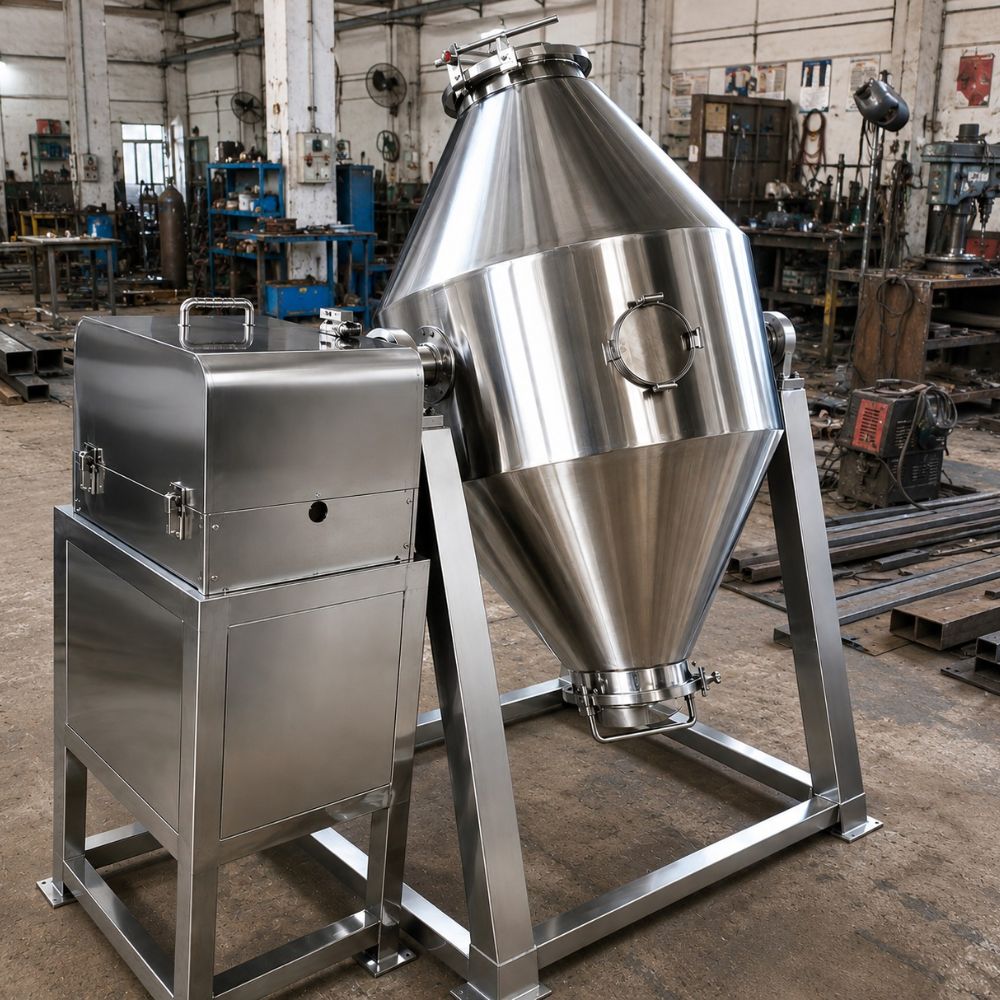
Double Cone Blender Mixer
Double Cone Blender Machine Manufacturer in India
The Double Cone Blender Mixer is designed for homogeneous mixing of dry powders and granules across various industrial applications. It is particularly suitable for spice manufacturers, masala processing units, food processing industries, and powder manufacturing businesses that require uniform distribution of multiple ingredients. The machine uses a rotating double-cone vessel to mix materials through continuous movement, tumbling, and blending.
The Double Cone Blender can be used for mixing different compatible ingredients before further processing, storage, or packaging. Its configuration can be selected according to batch size, material properties, mixing requirements, and the intended application. It is a practical solution for businesses looking to improve their powder mixing workflow and achieve consistent blending results.
What is a Double Cone Blender Machine?
A Double Cone Blender is an industrial mixing machine consisting of a double-cone-shaped vessel mounted on a supporting frame. The vessel rotates around its central axis, allowing the materials inside to move repeatedly from one section of the chamber to another. This movement promotes the distribution of ingredients throughout the batch.
The machine is commonly used for dry powder and granule mixing where controlled blending is required. Depending on the construction material and machine configuration, it can be considered for spice powders, seasoning blends, food ingredients, herbal powders, pharmaceutical materials, and selected chemical powders.
How Does a Double Cone Blender Work?
The working principle of a Double Cone Blender is based on tumbling and gravitational movement. First, the ingredients are loaded into the vessel through the charging opening. The vessel is then rotated by a motor and gearbox through the drive arrangement.
As the vessel rotates, the materials move, fall, and redistribute within the mixing chamber. Repeated movement helps different ingredients blend together and improves the distribution of smaller quantities of additives throughout the batch.
After the required mixing cycle, the machine is stopped and the blended material is discharged through the designated outlet. The actual mixing time and uniformity depend on the formulation, particle size, bulk density, filling percentage, vessel design, and operating speed.
Typical Mixing Process
Raw Material Preparation → Ingredient Weighing → Vessel Charging → Rotational Mixing → Blend Uniformity Check → Material Discharge → Storage or Packing
The precise process may vary according to the material being processed and the manufacturer’s recommended operating procedure.
Suitable Products
- Spice powders
- Masala mixtures
- Turmeric blends
- Red chilli blends
- Coriander powder blends
- Seasoning powders
- Food ingredient powders
- Dry premixes
- Herbal powders
- Pharmaceutical powders, subject to application requirements
- Selected chemical powders
- Compatible dry granules
Material suitability should be evaluated before processing. Products with significantly different particle sizes, densities, flow characteristics, or moisture levels may require specific mixing conditions to achieve the desired uniformity.
Main Components
1. Double Cone Vessel
The vessel provides the mixing chamber in which powders and granules tumble during rotation. Its capacity and construction are selected according to the intended batch size and application.
2. Drive Motor
The motor supplies the power required to rotate the vessel. Motor specifications depend on the machine design, load, and operating requirements.
3. Gearbox
The gearbox transmits power and provides the appropriate rotational speed for the mixing process.
4. Drive Arrangement
The drive assembly connects the motor and gearbox to the rotating vessel, supporting controlled operation.
5. Supporting Frame
The frame supports the vessel and drive components during operation. Its design should account for the machine’s weight, batch load, and operating conditions.
6. Charging Opening
The charging opening allows ingredients to be introduced into the mixing vessel. Its size and arrangement influence loading convenience and cleaning access.
7. Discharge Arrangement
The discharge outlet allows the finished blend to be removed after mixing. The outlet design should suit the material’s flow characteristics and downstream handling requirements.
8. Safety Arrangement
Suitable guards, controls, and other safety provisions help protect operators during operation. The specific safety features depend on the machine model and applicable requirements.
Key Features of a Double Cone Blender
Homogeneous Powder Mixing: The rotating vessel promotes repeated movement of materials, helping distribute compatible ingredients throughout the batch.
Gentle Tumbling Action: The machine mixes materials through rotational movement rather than relying solely on high-speed mechanical agitation. This may be suitable for applications where a tumbling-based mixing process is preferred.
Batch Processing: The blender processes a defined quantity of material per batch, making it suitable for production environments that prepare multiple formulations or product batches.
Flexible Applications: Depending on the construction and configuration, the blender can be used across food, spice, herbal, pharmaceutical, and selected chemical processing applications.
Convenient Material Handling: The charging and discharge arrangements can be selected to support the required loading, unloading, and downstream packaging workflow.
Customizable Construction: Mild steel, stainless steel, and SS-304 contact-part options may be available depending on the application and manufacturer’s specifications.
Applications of Double Cone Blender
The Double Cone Blender is widely relevant to businesses that need to combine dry ingredients before packaging or further manufacturing. Spice and masala producers can use it to mix compatible spice powders and seasoning ingredients. Food processing units may consider it for dry premixes and other powder formulations.
Herbal product manufacturers and selected pharmaceutical or chemical processing businesses may also consider this type of blender where the machine’s construction, cleaning requirements, and material compatibility meet their process specifications.
Advantages of a Double Cone Blender Mixer
- Supports blending of compatible dry powders and granules
- Promotes ingredient distribution through rotational tumbling
- Suitable for batch-based production
- Can accommodate a range of powder mixing applications
- Offers different vessel capacity and construction options, subject to availability
- Can be integrated into existing powder processing workflows
- Supports organized charging and discharge operations
- Suitable for spice, food, herbal, and selected industrial applications
Actual mixing performance depends on the material formulation, equipment design, operating conditions, and required quality standards. Mixing uniformity should be validated for critical applications.
Construction Options
Mild Steel Construction: Can be considered for suitable industrial applications where the material and operating environment are compatible with mild steel.
Stainless Steel Construction: May be preferred when corrosion resistance and cleaning requirements call for stainless steel construction.
SS-304 Contact Parts: Stainless steel 304 contact parts can be considered for appropriate food-processing applications, subject to the available design and required specifications.
Application-Specific Construction: Other materials or finishes may be considered depending on the product, cleaning procedures, and operating environment.
For food, pharmaceutical, and chemical applications, confirm all product-contact materials, surface finish requirements, cleaning procedures, and relevant compliance needs before purchasing.
Important Selection Factors
Before selecting a Double Cone Blender, consider the required batch size, bulk density, powder flow characteristics, particle size, ingredient proportions, target mixing uniformity, filling percentage, material of construction, and discharge requirements.
The nominal vessel capacity is not necessarily equal to the usable mixing volume. The appropriate filling percentage should be confirmed with the manufacturer based on the product’s characteristics and the intended mixing process.
Why Choose a Double Cone Blender Mixer?
A Double Cone Blender Mixer offers a practical solution for businesses requiring batch mixing of compatible powders and granules. Its rotating vessel supports ingredient distribution through repeated tumbling and can be incorporated into a larger production line involving weighing, grinding, sieving, storage, and packaging.
Whether you operate a spice manufacturing unit, a food processing business, or another powder-processing facility, selecting the right blender configuration is essential for achieving the required product quality. Contact the manufacturer to discuss your batch size, material properties, mixing uniformity requirements, construction preferences, and discharge arrangement before finalizing your machine selection.

Reviews
There are no reviews yet.